
Our Courses
Building Expertise to Combat Financial Crime
Our anti-financial crime training programs are designed to equip professionals with the knowledge and tools to effectively identify, prevent, and address financial crime risks. Key focus areas include anti-money laundering (AML), counter-terrorist financing (CFT), sanctions compliance, fraud prevention, and risk management.
We provide flexible training solutions, including in-person workshops, virtual sessions, and self-paced e-learning modules, customized to meet the unique needs of organizations across industries. Each program combines regulatory insights, practical case studies, and interactive exercises, ensuring participants gain valuable skills and actionable expertise.

High Stakes - How U.S. Casinos Facilitate Money Laundering from Fentanyl and Narcotics Trafficking
As concerns surrounding illicit financial flows in the gaming sector continue to escalate, this webinar is designed to provide compliance professionals, casino executives, law enforcement personnel, and financial institutions with essential insights into the methods criminal networks use to launder proceeds from fentanyl and other narcotics trafficking through casinos.
The session will explore the nexus between narcotics trafficking—specifically the fentanyl trade—and money laundering activities within U.S.-based gaming establishments. Participants will gain a deeper understanding of how criminal enterprises exploit casinos to legitimize illicit funds, learn to recognize key red flags associated with these schemes, and discover effective strategies to enhance anti-money laundering (AML) compliance within the casino industry.

Financial Crime Prevention and AML Compliance in the iGaming Industry
These courses provide a practical approach to combating financial crime in the online gaming (iGaming) industry. Designed for professionals such as compliance specialists, risk analysts, and law enforcement, the training covers AML/CFT regulations, investigations, and fraud prevention. Key topics include due diligence (KYC), identifying high-risk activities, and responsible gambling practices.
Through case studies and mock investigations, participants gain hands-on experience and actionable skills to effectively address financial crime and ensure regulatory compliance in the iGaming sector.
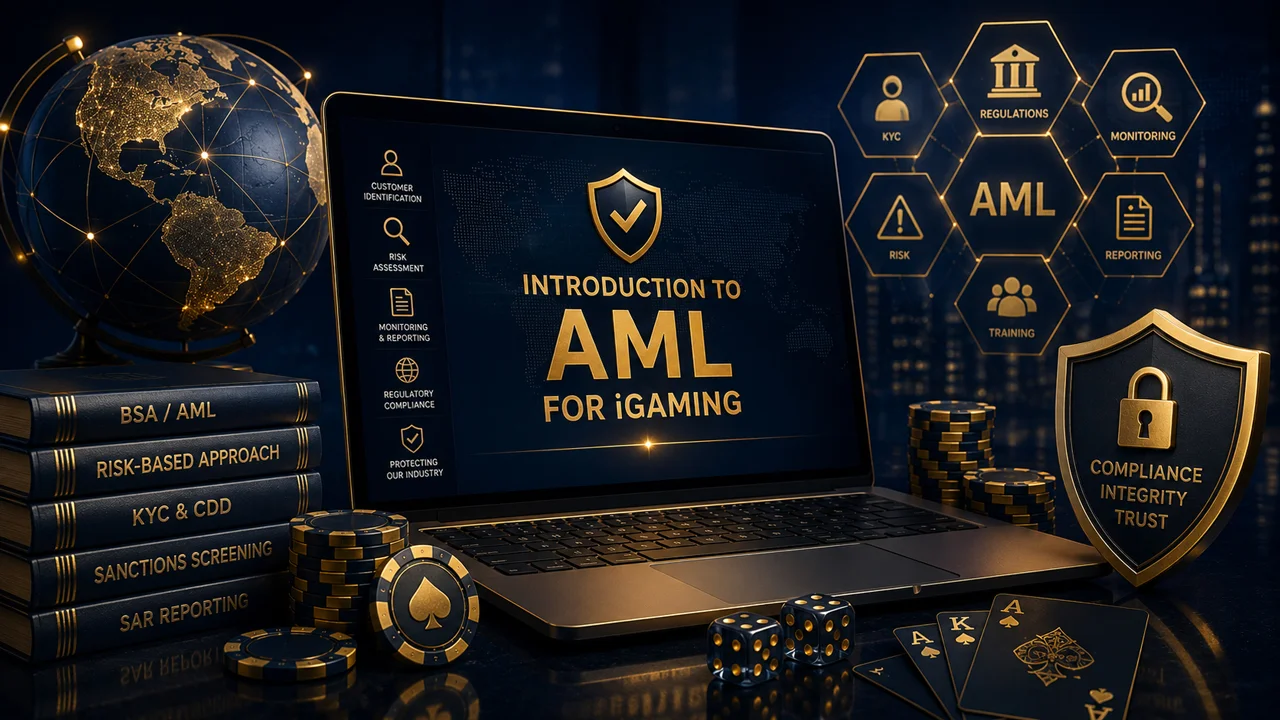
Introduction to AML for iGaming
Step into the high-stakes world where digital gaming intersects with financial crime risk, where the line between compliance and catastrophe is measured in milliseconds. “Introduction to AML for iGaming” is a comprehensive, real-world course designed for compliance professionals, operators, and decision-makers, providing a deep dive into how illicit funds move through modern gaming ecosystems and how leading operators stay ahead. Participants explore the full lifecycle of money laundering, from placement to layering and integration, while gaining practical insight into the evolving regulatory landscape, high-risk player behaviors, KYC and enhanced due diligence, transaction monitoring, and reporting obligations, supported by real enforcement case studies. Blending regulatory expertise with operational application, the course equips organizations with the tools to build, implement, and defend a robust, risk-based AML program that withstands both regulatory scrutiny and real-world threats.

KYC & Due Diligence for iGaming
Behind every player account lies a critical question: who is truly on the other side of the screen, and what risk do they bring? “KYC & Due Diligence for iGaming” is a comprehensive, real-world course designed for compliance professionals, operators, and decision-makers, exploring how effective onboarding becomes a frontline defense against financial crime. Going beyond basic verification, the course examines sophisticated threats such as synthetic identities, layered funding methods, and crypto obfuscation, while guiding participants through the full KYC lifecycle, from customer identification to Enhanced Due Diligence (EDD). Participants gain practical insight into detecting high-risk players, navigating evolving global regulatory expectations, balancing user experience with compliance controls, and leveraging automation, AI, and biometrics, supported by real enforcement case studies. With a strong focus on risk-based decision-making, documentation, and audit readiness, the course equips organizations to build and maintain a KYC framework that meets regulatory expectations and withstands real-world pressure.

High Stakes & Higher Risks: Enhanced Due Diligence in iGaming
In iGaming, not all players carry the same risk, and some can expose operators to significant regulatory, financial, and reputational consequences. “High Stakes & Higher Risks: Enhanced Due Diligence in iGaming” is a practical, risk-driven course designed for compliance professionals, operators, and decision-makers, focusing on how to identify, investigate, and manage high-risk players with precision and defensibility. Participants are immersed in real-world scenarios involving VIPs, politically exposed persons, and sophisticated bad actors, while learning to apply Enhanced Due Diligence (EDD) beyond standard KYC through advanced risk profiling, Source of Funds (SOF) and Source of Wealth (SOW) validation, dynamic risk scoring, and end-to-end investigative workflows. Supported by real enforcement case studies, the course emphasizes risk-based decision-making, documentation, and audit readiness, equipping organizations to operationalize and defend EDD frameworks that withstand regulatory scrutiny in an increasingly complex global landscape.
The Inside Game: AML Audits & Internal Reviews in iGaming
In iGaming, the greatest risk is not always the unknown, but the false assurance that controls are working when they are not. “The Inside Game: AML Audits & Internal Reviews in iGaming” is a comprehensive, real-world course designed for compliance professionals, operators, and decision-makers, reframing AML audits from a routine obligation into a strategic tool for identifying hidden weaknesses before regulators do. Participants are guided through the full audit lifecycle, from planning and testing to reporting and remediation, while learning to evaluate the true effectiveness of AML frameworks, distinguish between policy design and real-world execution, and apply advanced audit techniques such as risk-based sampling, walkthroughs, and system simulations. Supported by global regulatory expectations and real-world insights, the course equips organizations to identify and communicate findings with confidence, strengthen core AML pillars, and build resilient, audit-ready programs that stand up to regulatory scrutiny.